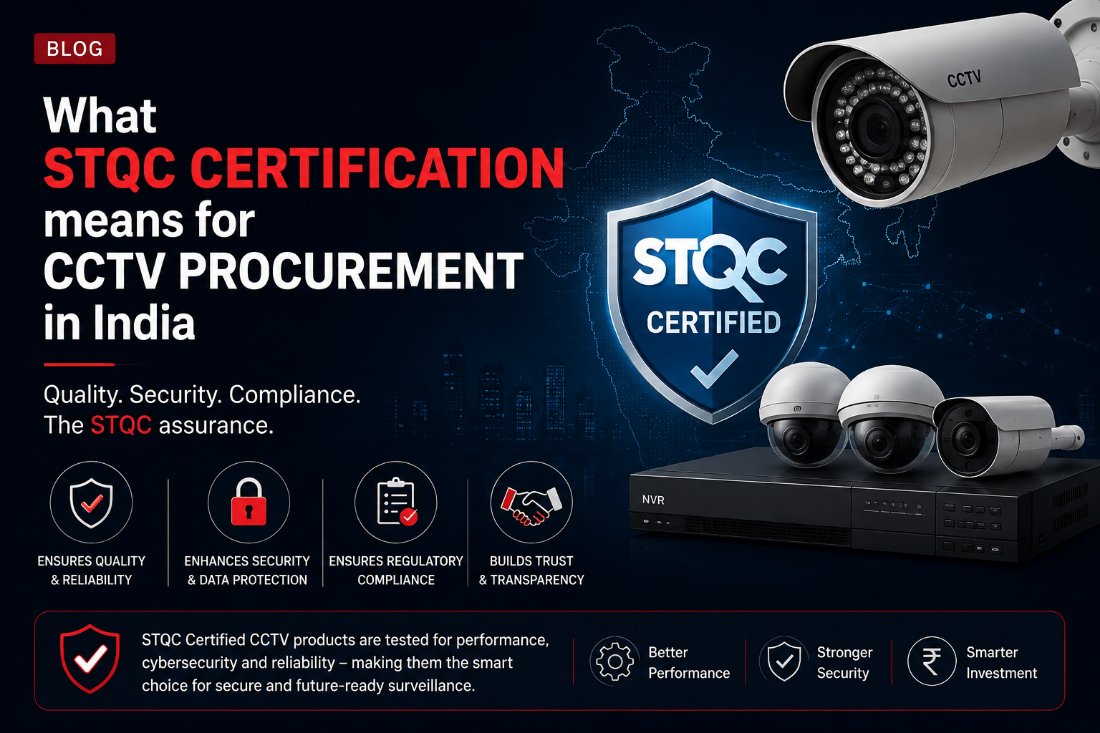
What STQC certification means for CCTV procurement in India
A growing number of government, PSU and even private-sector CCTV tenders in India now ask a question that used to be rare: is this equipment STQC tested? Here's what that actually means, and what it changes for anyone specifying or buying surveillance hardware.
What STQC actually is
STQC — Standardisation Testing and Quality Certification — is a testing and certification body under India's Ministry of Electronics and Information Technology (MeitY). It runs a network of labs across the country that evaluate electronics and IT products against defined technical and safety standards, and issue conformity certificates for products that pass. Its scope covers everything from consumer electronics to networking gear, biometric devices, and increasingly, surveillance hardware.
It isn't the only compliance mark that matters for electronics sold in India — BIS registration under the Compulsory Registration Scheme covers a separate, overlapping set of product categories — but for IT and security equipment specifically, STQC is the name that shows up most often in tender documents.
Why it's showing up in CCTV tenders now
Two things converged. First, India's public procurement policy has pushed steadily toward verified, security-cleared hardware for government and critical-infrastructure sites — a direct response to well-documented concerns about networked cameras with weak default credentials, unpatched firmware, or opaque supply chains ending up on sensitive premises. Second, CCTV stopped being a simple analog device and became a networked IT endpoint: a camera on a government LAN is now, functionally, a small computer with a lens attached, and it gets evaluated the way IT equipment gets evaluated.
The practical result: many police, defence, PSU and state-government tenders now specify that camera and recorder hardware must be STQC tested (or hold an equivalent recognised certification), and ask bidders to submit valid test certificates as part of the technical bid — not the commercial one. A BOQ that looks identical on price can be disqualified at the technical-evaluation stage if this documentation is missing.
What the testing actually checks
Scope varies by product category and the specific test scheme a tender references, but for networked surveillance equipment it typically touches:
It is not a statement that a specific camera is "unhackable" or that a vendor is broadly trustworthy — it's a conformity test against a defined scope, valid for a specific model and revision, for a defined period. That's an important distinction when you're reading a certificate someone hands you.
What to actually check before you buy
If a tender or internal policy requires STQC-tested equipment, a few checks save a lot of grief later in the technical evaluation:
Where this fits into a BOQ
For anyone specifying a deployment, the honest advice is to treat compliance documentation as a line item in the design phase, not an afterthought at bid submission. On the government, PSU and defence-adjacent sites we work on, we build certificate verification into the same BOQ and OEM-sourcing process as the technical spec — checking that what's proposed on paper is what's actually certified, before it goes into the tender response, not after a query comes back from the evaluation committee.
It's also why we lead with brands that already clear this bar. Every OEM in our surveillance portfolio — RoyalShield (the line exclusive to Front Vision), CP Plus, Honeywell, PRAMA and UNV — is STQC certified. Specifying from that pool from the outset means the compliance question is answered before the technical bid is written, not chased down afterward.
If you're scoping a surveillance rollout for a government office, PSU campus, or a corporate site that flows into government-adjacent supply chains, and want a second pair of eyes on the compliance side of the BOQ, that's a conversation we're set up to have.